


DRDC
Dairy Ecosystem
Research & Development Center
NEWS
- All
- Topic
- Research
- Event
- Topic Comprehensive collaboration agreement signed with Nippon Paper Industries Co., Ltd.
- Research Professor Toshihisa Sugino’s research was featured on NHK ONE
- Research Press Release: Approximately 260 million yen in funding has been secured for research on semen preservation methods for dairy cattle artificial insemination developed at Hiroshima University (video available)
- Event The 10th Hiroshima University Dairy Technology Seminar and the Commemorative Seminar for the Establishment of the DRDC Held in Tokyo
- Event We held the “2025 Memorial Service for Animals”
- Research Professor Toshihisa Sugino’s research was featured on NHK ONE
- Research Press Release: Approximately 260 million yen in funding has been secured for research on semen preservation methods for dairy cattle artificial insemination developed at Hiroshima University (video available)
- Research Press release: Study demonstrates that spore-forming lactic acid bacteria, probiotics, reduce diarrhea and improve growth performance
- Event The 10th Hiroshima University Dairy Technology Seminar and the Commemorative Seminar for the Establishment of the DRDC Held in Tokyo
- Event We held the “2025 Memorial Service for Animals”
- Event We have launched a “Practice of Smart Dairy Science”
- Event We have launched a “Life, Food and Agricultural Education through Experimental Studies of Dairy Farming”
- Event We have launched a “Field Practice of Dairy Production”
Dairy Ecosystem Research & Development Center

About the Dairy Ecosystem Research & Development Center
Located at the eastern end of the Higashihiroshima Campus, this farm focuses primarily on livestock. It raises dairy and beef cattle, sheep, and goats. Covering a total area of 35.1 hectares, the farm produces crops nourished by the power of the sun. These crops are used as feed to breed and raise livestock, producing milk, meat, and wool.
In particular, the farm maintains around 30 dairy cows, making it the only university-affiliated farm with a dairy division in the Chugoku, Shikoku, and Kyushu regions. Together with a food processing and experimental training plant for livestock products and a specialized crop research facility (the Precision Experimental Field), the farm plays a vital role in supporting the university’s educational and research goals.
Research Overview
Coming Soon
Facilities & Equipment
Coming Soon
Facility Use Guide
If you wish to use the farm, please carefully read the following guidelines and apply using the application form, preferably at least one month prior to your desired date of use.
If you have reference materials such as research plans or syllabus, please attach the files to the application form and submit them.
After receiving your application form, the center staff will review the details and contact you by phone or other means to inform you whether your request can be accommodated.
The information you provide will be used only to confirm your reservation and contact you regarding your reservation.
On the day of use, please complete the check-in procedure at the management office.
Use for Classes at Other Universities, General Visitors, and Our University Visitors
- Visiting Hours: The farm is open for visits from 9:00 a.m. to 5:00 p.m. on weekdays. For visits on weekends or public holidays, please contact us for prior consultation.
- Safety Precautions: Please be advised that dangerous equipment, including large agricultural machinery such as tractors and constantly electrified fences, are in operation on the farm. As these machines may use the same paths as visitors, we kindly request that the person in charge supervise all members of their party, including children, to prevent accidents.
- Feeding of Animals: Please refrain from feeding the animals under any circumstances, as they are part of a dedicated research program.
- Respect for Animals: Our livestock are sensitive animals. Please do not make loud noises or cause any disturbances within the animal enclosures, as this may startle them. Mother animals with their young are particularly sensitive, so please observe them quietly and respectfully.
- Adherence to Staff Instructions: Visitors are required to comply with all instructions given by our staff. Please be aware that certain areas, such as the animal sheds and fields, are restricted and not open to visitors.
- Transportation: Please conduct your visit on foot. If you are arriving by vehicle, please park it only in the designated parking area.
- Hygiene: Please do not touch the animals, their feces, or their food. Visitors are required to wash their hands thoroughly at a designated wash station or restroom during and after their visit.
- Prohibited Areas: For your safety, please do not approach ponds, marshes, or the slopes of embankments.
Use for Workplace Experience Programs
- Hours of the Program: The work experience program at the farm is available on weekdays from 9:00 a.m. to 5:00 p.m. We do not offer the program on Saturdays, Sundays, or public holidays.
- Eligibility: To ensure safety, this program is designed for junior high and high school students. We do not accept applications from elementary school students or younger. The program involves a full day of farm management tasks, including cleaning, removing manure, and feeding the animals.
- Group Size and Application: Applications are accepted for groups of five or more people. The application must be submitted by a responsible adult, such as a teacher.
- Insurance: Participants are required to have accident insurance or a similar policy.
- Availability: Please note that we may not be able to accept your application if we receive a large number of applications for the same period. We appreciate your understanding.
Use for Research Purposes
- Equipment and Vehicle Use
If you plan to use any equipment, vehicles, tools, or supplies within the facility, please consult with the technical staff in charge beforehand. After use, always return them to their original location. If any equipment, vehicles, tools, supplies, or parts of the facility are damaged or break while in use, notify the technical staff immediately. In cases of severe damage or malfunction, you may be required to pay for the repair or replacement. - Facility Use and Cleanup
After using any facility areas (e.g., animal dissection rooms, animal examination rooms), you must return the space to its original condition and clean it thoroughly. You are also responsible for managing your own personal gear, such as boots, work clothes, consumables, and small supplies. Any items left unused for more than a month may be disposed of. - Research Involving Animals
If your research involves bringing in animals from outside or requires long-term use (one month or more) of our facilities (including animal housing and experimental fields), your research plan may need to be reviewed and approved by the station or department meeting. As a result, we may not always be able to accommodate your request. - Animal Acquisition and Management
If you wish to bring in animals from outside or introduce animals that have been designated for a new use, the principal investigator is solely responsible for purchasing the feed, managing their care, and handling their disposition after the research is complete.
Temporary or Alternate Use
Reallocating Livestock for Research
If you wish to reallocate livestock for your research, you must include your request in our annual animal husbandry plan.Therefore, please submit your application by December of the previous year. Please note that we may not be able to accommodate all requests depending on the circumstances.
Use as a Circular Dairy Education Hub Considering Food Production Environment and Food Safety – for Field Education Programs
The Dairy Ecosystem Research and Development Center is the only facility in the Chugoku and Shikoku regions that offers dairy-focused education.
Utilizing our extensive grasslands and a large herd of dairy cows, in collaboration with other facilities (including the Precision Experimental Crop Field, Poultry and Livestock Environment Control Experiment Building, and Food Production Training Factory), we are a base for educational activities centered on dairy farming. Our mission is to promote “circular dairy education” that prioritizes both the food production environment and food safety.
For specific educational programs and information on our collaborative education facilities, please refer to the “Education Hub” page.
Guide to MEXT-Accredited Joint Usage and Education Centers

To provide high-quality education that responds to the increasingly diverse needs of both society and students, it is essential to promote the shared use of human and material resources across universities and to cultivate a wide range of advanced educational programs.
In September 2009, the Ministry of Education, Culture, Sports, Science and Technology (MEXT), Japan, launched a system to accredit MEXT-Accredited Joint Usage and Education Centers in order to support the development of such initiatives. Applications for accreditation are accepted nearly every year.
MEXT website:
「教育関係共同利用拠点について (about MEXT-Accredited Joint Usage and Education Centers)」
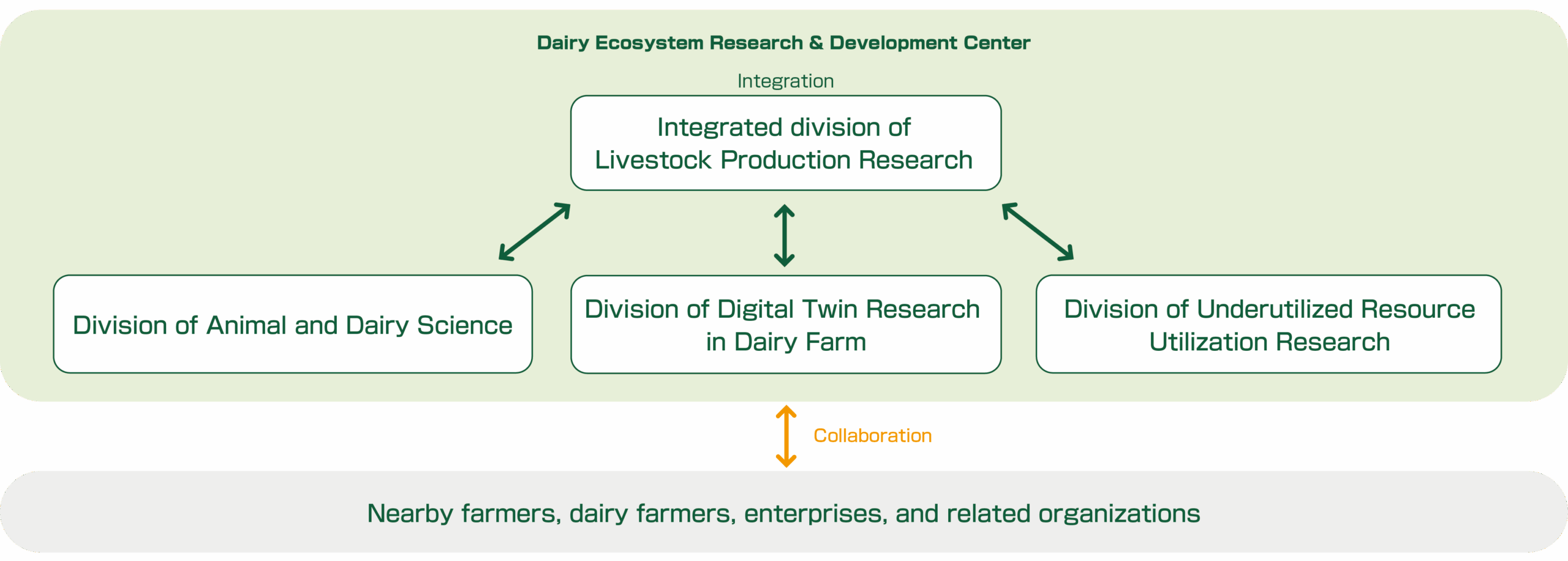
Center Collaboration Framework
“The university has reorganized and integrated its affiliated facilities—the University Farm, the Precision Experimental Field, and the Food Processing and Training Plant—which have conducted research on genome editing in livestock and poultry (for selective breeding of superior strains), reproductive technologies (for increased production), and feeding and management techniques (for efficient production).
By positioning the research infrastructure in the fields of animal husbandry and dairy science as the core, and involving researchers from the university’s science and engineering fields (such as information science and sensing technologies) as well as social sciences, we aim to strongly promote seamless research—from basic studies to practical implementation and social transformation—spanning laboratory to field scale.”
Contact & Access
2-2965, Kagamiyama, Higashi-Hiroshima, Hiroshima, 739-0046, Japan
TEL:+81-82-424-7994 (10:00~16:00)
FAX:+81-82-424-7971
E-mail:fscfarm*hiroshima-u.ac.jp
(Please replace the asterisk (*) with a half-width at sign (@))
ドローン_Moment.jpg)